
Working from home offers immense flexibility, but maintaining professional focus can be a constant battle. Whether it is barking dogs, lawnmowers outside, or family activity in the hallway, background noise regularly disrupts important virtual meetings and client presentations. If you are struggling to keep your audio clean, learning how to soundproof home office walls is the most effective way to protect your workspace.
Standard interior drywall partitions built across Northern Idaho often lack dense interior core insulation. Without high-density acoustic insulation installation, interior walls act like hollow amplifiers that transfer vibrations directly into your workspace. By upgrading your wall cavity to soundproof home office walls, you can eliminate distracting ambient sounds and transform your office into a quiet, focused studio.
Understanding STC Rating Walls and Noise Transfer
When planning an acoustic upgrade, the primary performance metric to evaluate is the Sound Transmission Class (STC). The STC rating measures how effectively a building assembly dampens airborne noise, such as human speech, television audio, or ringing phones.
- Standard Interior Wall (STC 30–34): A basic hollow drywall wall lets normal conversation pass through easily.
- Insulated Interior Wall (STC 45–50): Adding high-density rockwool or specialized mineral batt insulation reduces perceived noise by up to 50%, rendering loud speech down to a faint, unintelligible whisper.
- De-coupled Acoustic Wall (STC 55+): Combining high-density batts with resilient channels or mass-loaded vinyl blocks low-frequency vibrations and high-decibel disturbances.
Achieving a high STC rating on interior walls requires replacing light, hollow air spaces with dense material designed specifically to absorb sound waves rather than transmit them.
Why Use Rockwool Safe and Sound in Idaho Homes?
To build an impenetrable acoustic barrier, selecting the right material is critical. Traditional thermal fiberglass batts are engineered for temperature retention, not sound absorption. For interior acoustic upgrades, material density is what absorbs vibrating sound waves.
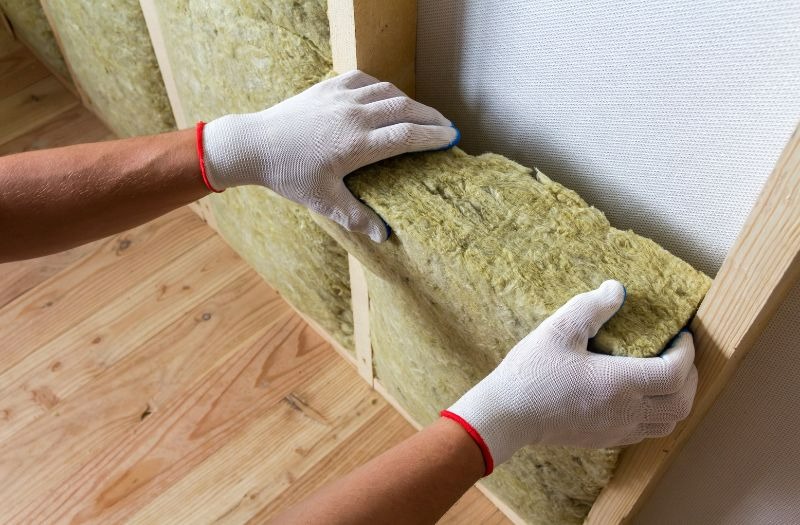
Products like Rockwool Safe and Sound in Idaho homes have become the industry standard for home office conversions. Made from natural stone wool, this high-density stone wool insulation provides key advantages over standard fiberglass:
- Superior Sound Absorption: The open-porous, dense stone wool fiber structure traps sound waves, stopping sound energy from traveling through stud bays.
- Precision Friction Fit: The rigid batts fit tightly between standard 16-inch or 24-inch stud cavities without slumping over time, preventing acoustic gaps.
- Fire Resistance & Moisture Protection: Stone wool is non-combustible and water-resistant, adding safety and structural protection to your home interior.
Key Steps for High-Density Acoustic Insulation Installation
Upgrading your home office walls involves a systematic process to ensure complete noise containment. Even small air gaps can leak significant sound into an otherwise quiet room.
1. Wall Cavity Preparation
To properly soundproof home office walls, existing drywall on at least one side of the partition must be removed to expose the framing studs. Any electrical outlet boxes, switch plates, or HVAC vents must be identified, as these bypasses require specialized acoustic putty pads to prevent flanking noise.
2. Precision Insulation Fitting
Your installer will friction-fit high-density acoustic batts firmly into every stud cavity. The material is cut precisely around electrical wiring and junction boxes to eliminate empty air pockets.
3. Acoustic Sealing and Drywall Upgrades
Once the acoustic insulation installation is complete, heavy 5/8-inch drywall or specialized sound-dampening drywall is installed over the studs. Acoustic sealant is applied along the perimeter floor plates, ceiling line, and corner joints to ensure a complete air-tight acoustic seal.
Reclaim Your Focus and Professional Privacy
When you take steps to soundproof home office walls, you do more than just keep your video calls quiet—you provide complete privacy for sensitive business discussions and allow yourself to work without household distractions. Investing in high-density acoustic insulation transforms a standard spare bedroom into a high-performance executive workspace.
If you are ready to eliminate household noise and upgrade your home office, visit our services page to explore our specialized wall insulation solutions. You can also view our why choose us page to learn about our installation standards, or head to our contact us page to schedule an acoustic evaluation with our team today.