
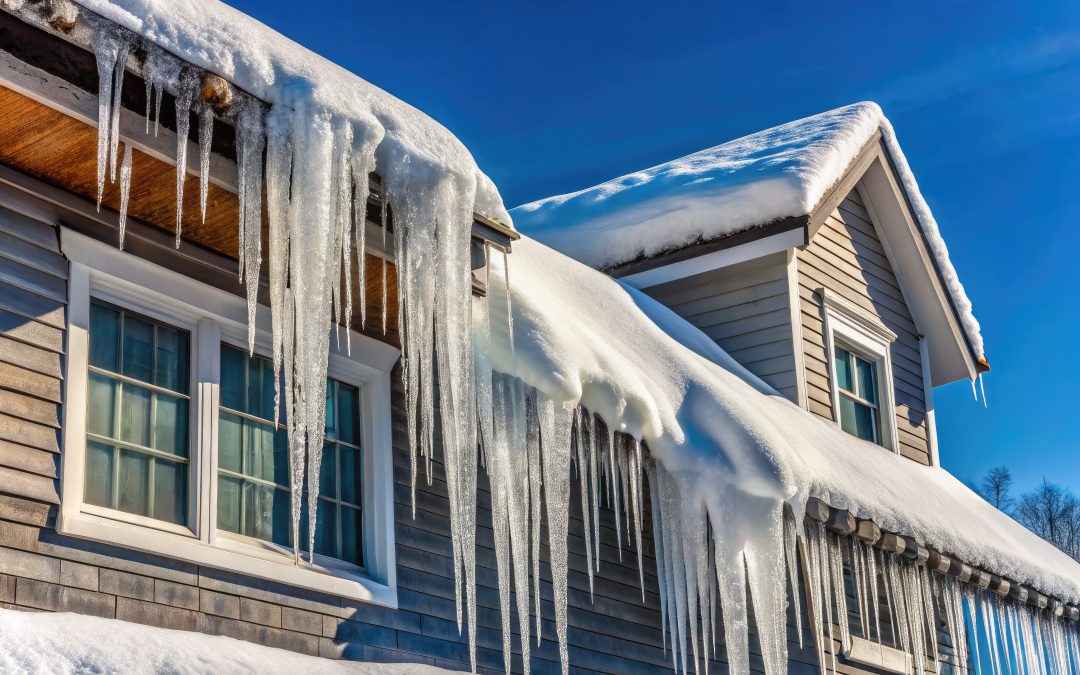
Imagine, a homeowner in Twin Lakes Village calling us after discovering water stains on their living room ceiling—directly below what they thought were “pretty icicles” on the roof. Those icicles could cause thousands of dollars in roof and interior damage.
If you’ve noticed icicles forming along your roofline, understand this: they’re not winter decorations. They’re warning signs that ice dams are forming, and ice dams can cause serious damage to your Rathdrum area home.
What Icicles Really Mean
Icicles form when heat escaping from your home melts roof snow, that meltwater runs to your cold roof edge, and refreezes. This reveals a critical problem: inadequate insulation and ventilation.
Here’s the destructive cycle: Heat from your living space rises into your attic and warms the roof deck above 32°F. This melts snow on your roof. The meltwater flows down until it hits your cold eaves (the overhang beyond your heated space) and refreezes instantly.
Layer after layer of ice builds up, creating a dam. Trapped meltwater backs up under your shingles, through your roof deck, and into your home. The visible icicles are just the surface—massive ice dams form behind them.
Why North Idaho Homes Are Vulnerable
Insulation contractors across Kootenai County consistently find three problems that make homes especially prone to ice dams:
Inadequate attic insulation: Most Rathdrum homes built before 2000 have R-19 or less. Idaho’s climate zone requires R-49. That missing insulation allows heated air to rise directly into attics, warming roof decks and melting snow from below.
Air leakage: Recessed lights, bathroom fans, chimney chases, and attic hatches create pathways for warm air to bypass insulation entirely. Thermal imaging reveals heat pouring through dozens of unsealed gaps in Spirit Lake and Hayden homes.
Poor ventilation: Blocked soffit vents and inadequate exhaust vents trap warm air in attics. Without proper airflow, escaped heat accumulates and creates perfect ice dam conditions.
The Real Damage Ice Dams Cause
Once water backs up behind an ice dam, it penetrates every gap in roofing systems.
Immediate damage seen every winter:
- Water-stained ceilings and walls
- Peeling paint and damaged drywall
- Soaked insulation that loses all effectiveness
- Mold growth in attics and wall cavities
Long-term structural damage:
- Rotted roof decking requiring replacement
- Damaged roof trusses and rafters
- Deteriorated fascia and soffit boards
- Warped wall framing where water penetrates
And if just one winter of ice dams can cause considerable damage, imagine how much damage several winters of ignored ice dams can cause? Icicles are not “just part of Idaho winters.”
The Only Solutions That Actually Work
Heated cables treat symptoms, not causes. They consume electricity all winter and don’t address the insulation problems creating ice dams. Here are the permanent solutions:
Upgrade Attic Insulation to R-49
Proper insulation keeps heat in living spaces instead of warming roofs. For Rathdrum’s climate, homes need R-49 throughout attics—approximately 16-18 inches of blown-in cellulose or fiberglass.
Critical details: maintain uniform depth across entire attics, use baffles at eaves to prevent blocking soffit vents, and never compress insulation.
Seal All Air Leaks
Before adding insulation, seal every attic floor penetration: recessed lights, exhaust fans, plumbing vents, electrical wires, chimney chases, and attic hatches. Professional air sealing reduces heat loss 30-40% before adding a single inch of insulation.
Balance Attic Ventilation
Attics need equal intake ventilation (soffit vents) and exhaust ventilation (ridge or roof vents). The standard is one square foot of ventilation per 150 square feet of attic space. Proper ventilation keeps roof decks cold regardless of minor heat escape.
What to Do If You See Icicles Now
Immediate steps:
- Safely remove accessible snow from roof edges using a roof rake (never climb on icy roofs)
- Check attics for wet insulation, water stains, or ice accumulation
- Inspect ceilings near exterior walls for water damage
- Clear ice from gutters to allow drainage
Don’t:
- Chip away ice dams with tools (damages shingles)
- Apply salt or chemicals to roofs (damages materials)
- Ignore the warning signs
Stop Ice Dams Before They Start
Every winter with inadequate insulation is another winter of ice dam risk and cumulative damage that becomes more expensive to repair.
Westwood Insulation has prevented ice dams in hundreds of Kootenai County homes through proper insulation and air sealing. Our company understands exactly why North Idaho homes develop ice problems and the proven solutions for the region’s climate.
If you’re seeing icicles on your Rathdrum, Post Falls, or Coeur d’Alene home, don’t wait for water damage to force action. Call Westwood Insulation at (208) 916-5159 for a free attic assessment. Our team uses thermal imaging to identify heat loss patterns, evaluate insulation and ventilation, and provide detailed plans to eliminate ice dams permanently. Protect your home before the next heavy snowfall arrives.